Menu

Call This Thursday Get $50 Off Today
24 Hour Services
7 Days a Week
Call This Thursday Get $50 Off Today
24 Hour Services
7 Days a Week
Having a clogged plumbing fixture can be frustrating. When your kitchen sink doesn’t drain well, you’ll find it hard to prepare food and wash your dishes. When your toilet has a blockage, you won’t be able to do number ones and twos since you can’t flush them down properly.
Now imagine how hard it can be when your entire plumbing system becomes blocked. Instead of having the problem confined to a single, isolated area, you’ll find that all of your plumbing fixtures won’t function properly. Since water has nowhere else to go, it will definitely back up and flow to the path of least resistance, which is usually your basement drain or your ground-floor toilets. You’ll also notice an awful smell since raw sewage won’t be carried away and will hang around your drains.
So what should you do when you have a backed-up sewer line? Well, the first step you should take is to tell your entire family to avoid using any plumbing fixture. This way, you won’t add any more water to your plumbing system and increase the pressure inside it.
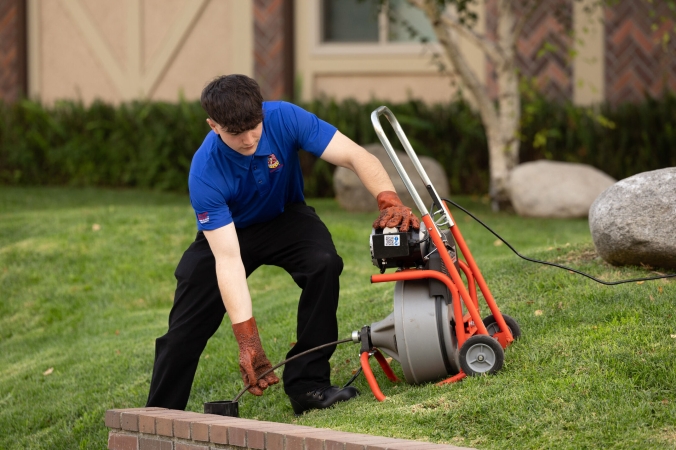
After warning your family members, gather the tools you’ll need. You should have a pair of pliers, an auger (also called a plumbing snake), and a sewer rod (also known as a sewer line snake) on hand. You should also wear goggles, rubber boots, and rubber gloves to protect yourself from the waste water and raw sewage you may be dealing with.
Once you have everything you need, hunt for the main sewer cleanout pipe. Ideally, it has a lid that’s labeled “Sewer Clean Out” or just “Clean Out”, but it can also be a Y- or T-shaped pipe that seems to be a dead end. It’s usually located in your yard around three feet from your house (if your garden has been landscaped in the past, you may have to dig around a bit since it may be buried underneath some dirt or mulch). You may also find it in your basement or crawl space, depending on how your house was designed.
Once you find your cleanout pipe, open its plug using your pliers. Expect a substantial amount of waste water to pour out so, if the pipe is vertical, you may want to put a bucket under it to catch the dirty water. After all the water has drained, guide your auger’s cable into the hole and push until it hits an obstruction. Crank the handle clockwise to make the cable catch on the clog and, when it does, push and pull until the blockage breaks apart. You can also thread the sewer rod into the hole until it reaches the obstructed part, move it around to ensure it catches on the blockage, and slowly pull the rod back out. Doing this may pull out the clog that’s causing your drainage problems.
If you’ve done the steps listed above but still have a problem with your drainage, call a plumber ASAP. A professional plumber has the right tools, skills, and knowledge to repair your backup-sewer line and get it back into shape in no time.

A kitchen stays busy all day. When something slows down the flow of…

A good look inside a drain line tells you the truth faster than…

A sewer line problem interrupts daily life quickly. Rooter Guard sees this…

A plumbing system reaches a point where repairs stop making sense. Many homeowners…

A dead disposal can bring a busy kitchen to a stop. When that…
Water pressure can make or break your plumbing experience… almost literally. Low water pressure can make washing pots and pans a nightmare, and high water pressure can push water through joints and crevices before causing a burst pipe. Water pressure problems are sneaky and often start small, but they usually…
Learn More