Menu

Call This Saturday Get $50 Off Today
24 Hour Services
7 Days a Week
Call This Saturday Get $50 Off Today
24 Hour Services
7 Days a Week
California delivers some of the hardest water in the country to residential and commercial properties. Hard water leaves its evidence everywhere it contacts. Scale builds up inside pipes, within appliances like water heaters and dishwashers, and even on plumbing fixtures and glassware.

A traditional water softener and a salt-free water conditioner tackle hard water in very different ways:
A salt-based softener gives homeowners the strongest protection against hard-water scale, but there are legal considerations in California. On the other hand, a salt-free conditioner does not remove those minerals. Instead, it conditions the minerals so they have less tendency to form scale.
So, the real question goes beyond “softener or conditioner?” It starts with the water, the property's goals, and the local rules. This article brought to you by the plumber team at Rooter Guard, we break down the basics.
Throughout Southern California and the Central Valley, water traveling through mineral-rich geology picks up calcium and magnesium concentrations that register as very hard to extremely hard by industry measurement standards.
The consequences of hard water are plenty:
Both salt-based water softeners and salt-free conditioners address these problems… but through different mechanisms, with different results, and under different regulatory conditions across California.
A traditional water softener uses an ion-exchange process to remove calcium and magnesium from the water supply entirely.
In short, water passes through a resin tank filled with sodium-charged beads, and the resin attracts the calcium and magnesium ions and releases sodium ions in exchange. This effectively trades the hard water minerals for sodium before the water reaches any fixture or appliance in the home.
This process actually removes the hardness minerals, and this difference matters for households that want the strongest reduction in hardness.
However, salt-based systems require regeneration. The system flushes the resin with a salt solution, and that process creates brine wastewater. California law allows qualifying local agencies to regulate this source of salinity, including restrictions on installation or requirements for more efficient equipment.
A salt-free conditioner takes a completely different approach. Instead of removing calcium and magnesium, the system changes how those minerals behave. Depending on the technology, the treatment can reduce the minerals' tendency to form hard scale on plumbing surfaces.
To be clear, a conditioner does not create truly soft water. The minerals remain in the water and pass through the system, but they travel in a form that prevents the scale adhesion that untreated hard water produces. Existing scale deposits gradually break down as conditioned water passes through them.
Salt-free conditioners require no regeneration cycle, produce no brine discharge, and operate within California's water reclamation framework without restriction. They work without electricity, require no maintenance salt purchases, and qualify as legal installations throughout the state.
It’s always advisable to consult a trained plumber when deciding between a water softener installation and a salt-free conditioner, but a few questions can narrow the decision:
Does the household want actual mineral removal? A traditional softener fits that goal.
Does the household mainly want scale control without salt regeneration? A salt-free conditioner may fit better.
Does the local community restrict salt-based systems? Check the applicable city, water district, or wastewater rules before purchasing equipment.
Does the property already have serious scale or plumbing problems? A plumbing repair service can resolve those problems before moving toward treatment solutions.
There is no universal winner between a softener and a salt-free conditioner. The right choice depends on the property's water chemistry, the owner's goals, existing plumbing conditions, and applicable local requirements.
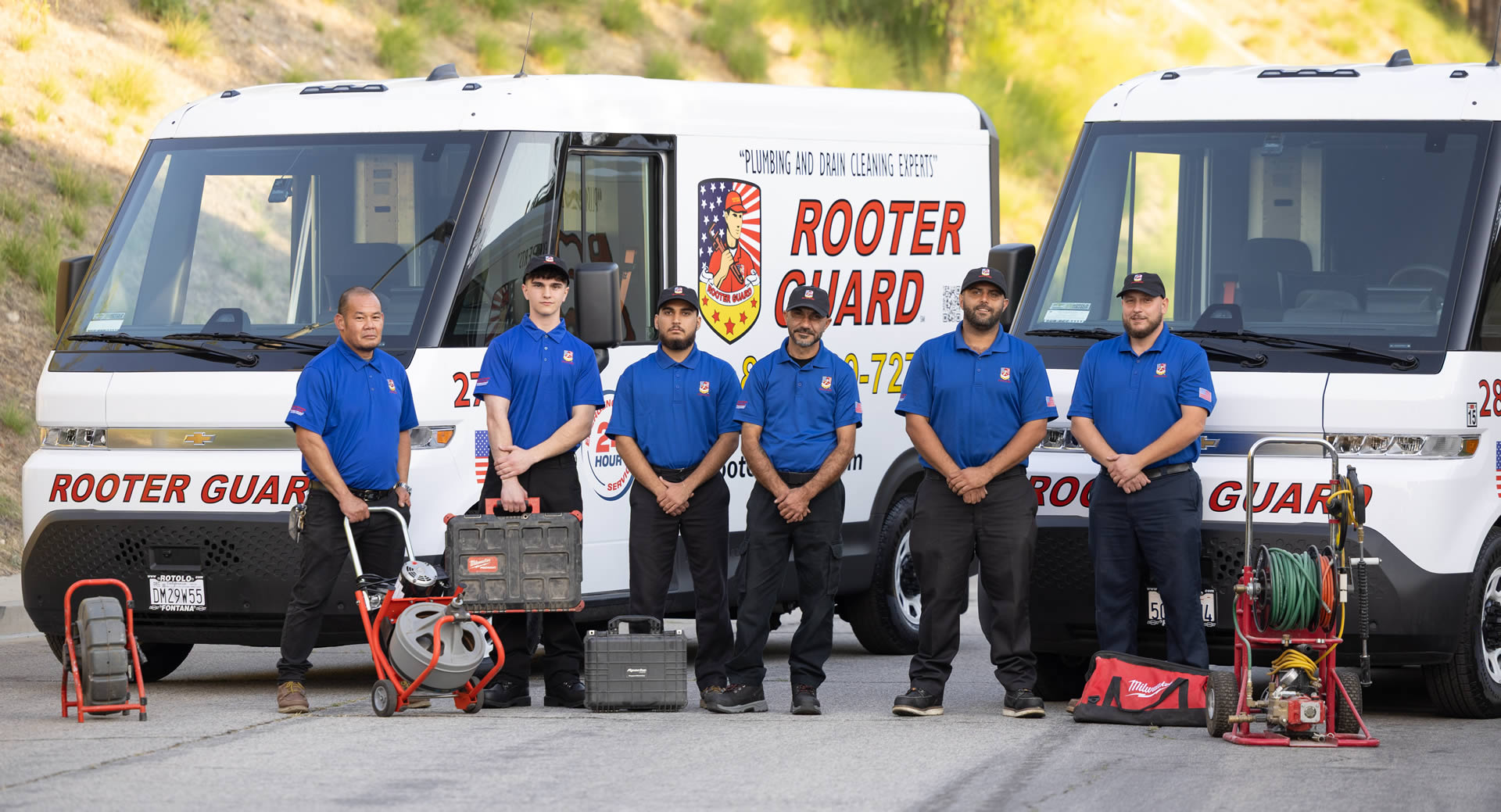
If you’d rather consult a trained and experienced plumber in Woodland Hills, then contact the uniformed professionals at Rooter Guard.
We are a full-service plumbing company serving residential and commercial properties throughout the Los Angeles area, and we handle everything from minor repairs to water softener installation and replacements, and more.

A kitchen stays busy all day. When something slows down the flow of…

A good look inside a drain line tells you the truth faster than…

A sewer line problem interrupts daily life quickly. Rooter Guard sees this…

A plumbing system reaches a point where repairs stop making sense. Many homeowners…

A dead disposal can bring a busy kitchen to a stop. When that…

Standard plumbing snakes often provide only a temporary fix by punching a narrow hole through a blockage (without addressing the root cause). Moreover, recurring main line clogs usually point to deeper issues like heavy grease buildup, tree root intrusion, or structurally damaged pipes that standard tools simply cannot resolve. To…
Learn More