Menu

Call This Thursday Get $50 Off Today
24 Hour Services
7 Days a Week
Call This Thursday Get $50 Off Today
24 Hour Services
7 Days a Week
If you are noticing some problems with the amount of hot water in your shower, it might be that your thermostatic shower valve is damaged. This is the component that controls the water flow through the shower head. Aside from an insufficient amount of hot water you are receiving from the shower system, other signs that indicate this part is no longer functioning well and already needs fixing or replacement include are leaks and slow reaction.
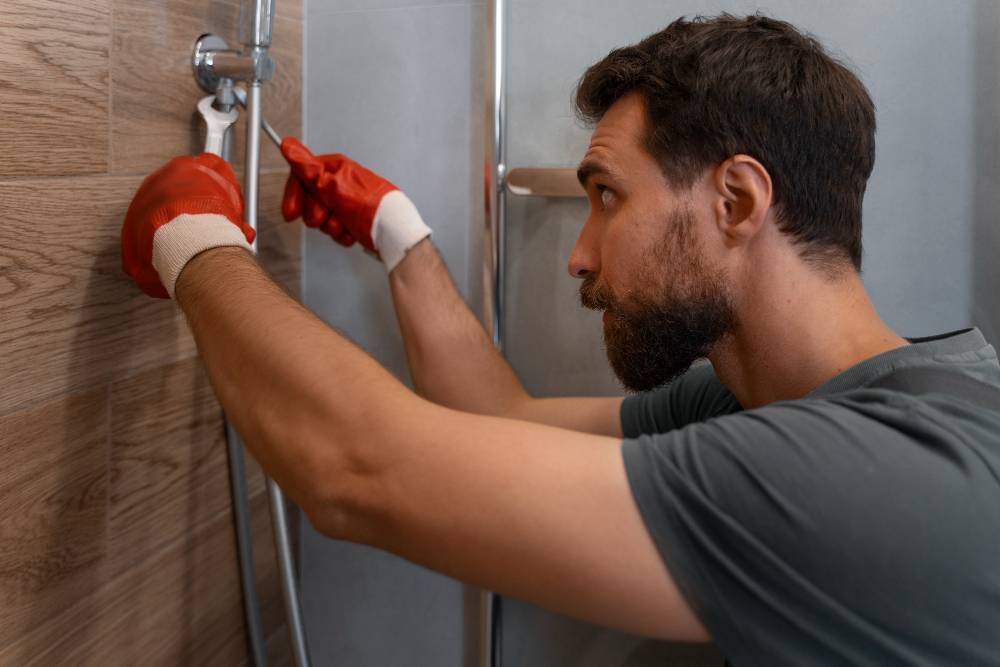
If you are experiencing this type of problem, take note that there is no huge difference between a thermostatic shower and a regular shower system, which means that you would not need to call on a professional fix it for you, especially when you are quite good in doing DIY projects. Just follow these simple steps to repair a thermostatic shower.
1. Secure the tools and materials that you will need, including Phillips and flat head screwdrivers, deep socket wrench, a pair of pliers and a new thermostatic shower valve.
2. Using a flat head screwdriver, take off the cap of the shower handle to get access to the screw that you should remove using a Philips screwdriver. Beneath this screw, you will also find another screw that you also have to remove in order to remove the lever handle.
3. After you have completely removed the shower handle, it is time to remove handle faceplate. In doing so, see to it that you set aside the components you remove in a safe area in your bathroom, so you will not have any difficulty reassembling them later on.
4. By this time, you will be able to see a hole on the wall, which is part of the thermostatic valve. If there is a stop check valve, you will need to shut them off, and if there is not any, you need to completely shut off the main water supply to your home.
5. After ensuring the water supply is shut off, remove the valve cartridge. Take note that this component is shaped like a “U” in some units, and can be removed using a pair of pliers. For other units, they have bolts and nuts that you need to remove to take the cartridge off.
6. With the cartridge removed, you will now be able to remove the entire thermostatic system, along with the hose and shower head, from the water supply. Disconnect the hot and cold water supply from the valve to remove the actual valve itself.
7. Place the new valve where it should be. Simply replace the components in a reverse order when you removed them, turning the valve back on and re-installing the faceplate and handle.
8. Test if the problem is solved by turning the water back on and testing the temperature.
While thermostatic valves come in the more common manual form, they can also come in a digital electronic form. For the manual type, it uses heat-sensitive material, which expands with heat to restrict the flow of hot water. On the other hand, the digital electronic type have no moving parts to control the amount of hot water released, but instead use semiconductor devices, such as thermistors. Knowing which type you are having is important before you start the repair work.

A kitchen stays busy all day. When something slows down the flow of…

A good look inside a drain line tells you the truth faster than…

A sewer line problem interrupts daily life quickly. Rooter Guard sees this…

A plumbing system reaches a point where repairs stop making sense. Many homeowners…

A dead disposal can bring a busy kitchen to a stop. When that…
Water pressure can make or break your plumbing experience… almost literally. Low water pressure can make washing pots and pans a nightmare, and high water pressure can push water through joints and crevices before causing a burst pipe. Water pressure problems are sneaky and often start small, but they usually…
Learn More